How decades of business travel and global flavour exploration inspired an entrepreneur to rethink the way India experiences beverages.
India’s food and beverage industry has evolved considerably over the past decade. From regional delicacies and experimental cuisines to premium dining experiences, Indian consumers are increasingly exploring new tastes and experiences. However, while food has witnessed a remarkable transformation, the cocktail and mocktail segment still presents opportunities for greater innovation, particularly in flavour, accessibility, and the overall drinking experience.
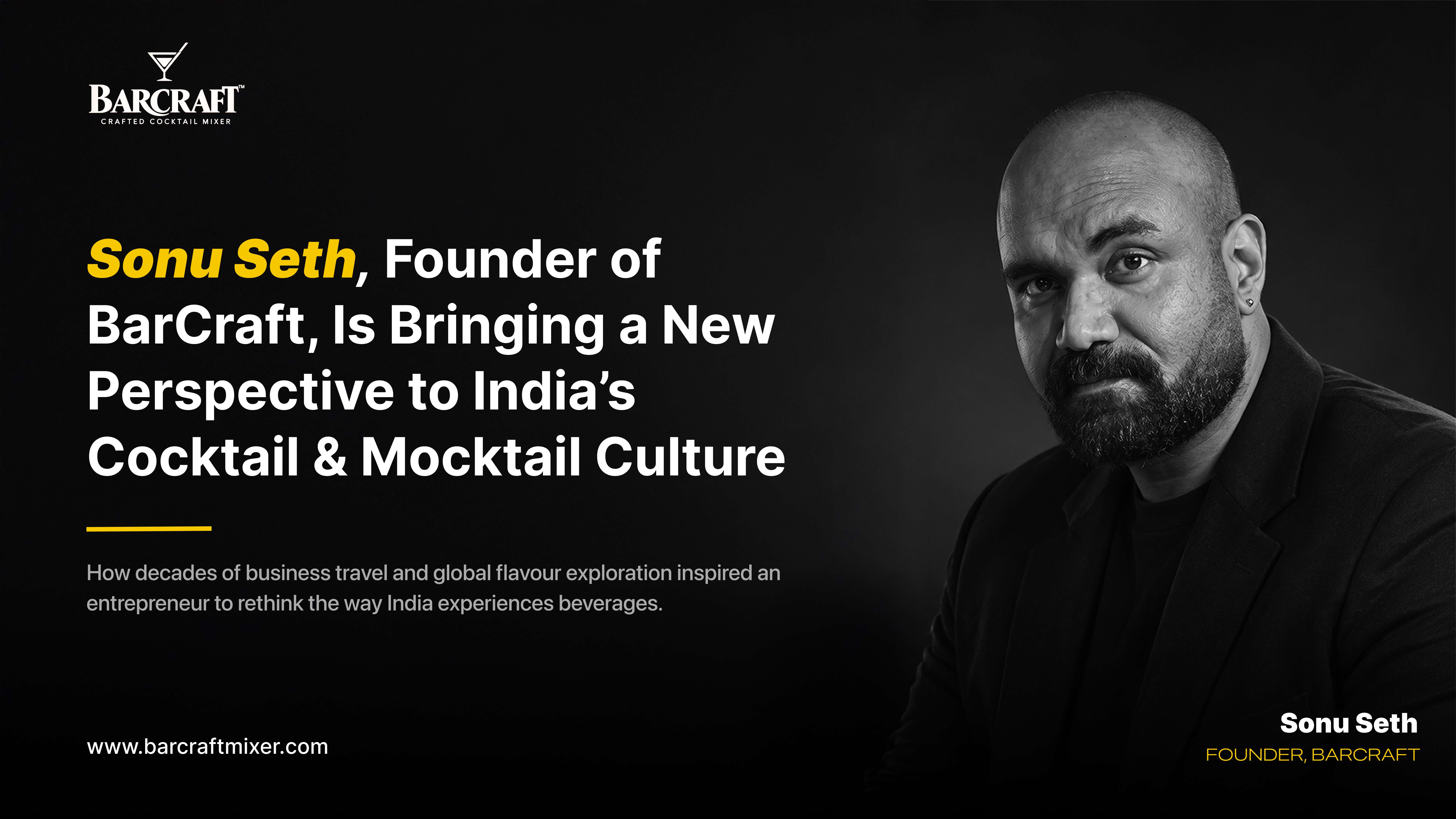
For entrepreneur Sonu Seth, Founder of BarCraft, this observation became the starting point for a new business idea. Shaped by decades of business travel, exposure to different markets, and experience in the supplement industry, Seth began looking at India's beverage culture from a different perspective. What emerged was a simple question: why should enjoying a well-crafted drink require a visit to a bar, access to a professional bartender, or a complicated preparation process?
His answer took shape as BarCraft, a beverage brand built around the idea of making distinctive cocktail and mocktail experiences more accessible to Indian consumers.
A Business Journey Shaped by Global Exposure
Seth's journey towards BarCraft did not begin in the beverage industry. His professional experience in the supplement business and years of travelling across markets exposed him to different consumer preferences, product categories, and business environments. These journeys also introduced him to diverse food cultures, beverage traditions, and flavour combinations.
Over time, these experiences influenced the way he viewed products and consumer experiences. Beyond the functional aspects of a product, he became increasingly interested in what makes an experience memorable, how flavours influence consumer preferences, and how products can be developed to meet expectations that existing offerings may not fully satisfy.
Travelling across markets provided him with a broader understanding of how consumers experience food and beverages. It also encouraged him to look beyond established categories and identify opportunities where consumer expectations and available products did not always align.
When he returned to India, this perspective led him to examine the country's beverage landscape more closely. He saw a market with considerable potential, supported by evolving consumer preferences and a growing interest in experimenting with food and drinks.
Yet, he felt that the beverage experience had not progressed in the same way as India's food culture.
Identifying the Missing Element in India's Beverage Experience
India has a rich and diverse culinary identity. Regional ingredients, bold spices, traditional preparations, and innovative combinations have become central to the country's evolving food culture. Seth believed that the same emphasis on flavour, creativity, and variety deserved greater attention in beverages.
In his observation, the cocktail experience often placed greater emphasis on alcohol, while the flavour balance, complexity, and character of the drink did not always receive the attention they deserved. Mocktails presented a different challenge, with consumers sometimes finding limited variety when looking for distinctive, well-balanced, and flavourful options.
Access was another part of the problem. A consumer wanting to enjoy a carefully prepared cocktail or mocktail could find themselves relying on a bar, pub, club, or bartender. Recreating a similar experience at home could involve sourcing several ingredients, following unfamiliar recipes, and getting the proportions right.
For Seth, this created a gap between what consumers could potentially experience and what was convenient for them to prepare in their everyday lives.
The opportunity, therefore, was not simply to introduce another syrup or beverage product. It was to rethink the preparation and consumption experience around flavour.
He began exploring how the complexity of a well-crafted drink could be simplified without losing the character that makes it enjoyable. Could consumers have access to more distinctive flavours without needing extensive ingredients, specialised knowledge, or professional preparation?
This question became central to the thinking behind BarCraft.
BarCraft: Turning a Market Observation into a Brand
BarCraft was conceived around a straightforward proposition: make the experience of creating cocktails and mocktails simpler, while keeping flavour at the centre of the experience.
The brand focuses on cocktail concentrates designed to help consumers prepare drinks with greater ease. Rather than requiring multiple ingredients and elaborate preparation, the concept aims to offer a more convenient way to create a variety of beverages at home and during social occasions.
The idea reflects Seth's broader approach to entrepreneurship: identifying an everyday consumer problem and exploring how a product can address it in a practical, experience-led way.
For BarCraft, convenience alone was not enough. The quality and intensity of flavour were equally important to the proposition. Seth saw an opportunity in a cocktail syrup market where, in his assessment, existing options did not always deliver the depth of flavour and premium experience he believed consumers were looking for.
Instead of treating the availability of competing products as proof that the market was already adequately served, he saw room to improve the experience.
The intention was to offer consumers a more distinctive flavour profile while remaining accessible at a comparable price point. The brand's product development and tasting comparisons were part of this effort to understand how its offering could stand apart.
This approach positioned BarCraft around a clear objective: addressing the perceived gap between the availability of cocktail concentrates and the flavour experience consumers actually want.
Making the Beverage Experience More Accessible
One of the central ideas behind BarCraft is that a good drink should not be limited by where it is consumed or who prepares it.
Home gatherings, house parties, family celebrations, and informal get-togethers are all occasions where consumers may want something more interesting than conventional soft drinks, without the complexity of preparing a cocktail from scratch.
BarCraft aims to make that experience easier to achieve. Its pocket-sized cocktail concentrate concept is designed around convenience, portability, and ease of preparation, allowing consumers to explore different drink options without setting up a complete home bar.
The concept also creates room for consumers to experiment with beverages according to their preferences and occasions. By simplifying preparation, the brand seeks to make flavour exploration less intimidating for people who may not have the knowledge or equipment required to prepare traditional cocktails.
For consumers who prefer non-alcoholic options, mocktails offer another way to explore different flavour combinations. The broader vision is to make a more varied drinking experience accessible across different social settings and personal preferences.
This is where the idea of a more accessible beverage culture becomes important. Rather than making consumers adapt to complicated preparation methods, BarCraft seeks to bring a simpler approach to them.
Building a Brand Around Flavour, Not Just Convenience
For Seth, BarCraft represents more than a convenient way to prepare drinks. It reflects a larger belief that flavour should be a defining part of the beverage experience.
His exposure to different markets helped shape his understanding of how beverages can contribute to social occasions, complement food, and become memorable in their own right. Bringing that perspective to India meant recognising that the opportunity was not limited to introducing new products. It also involved encouraging consumers to think differently about what they drink.
India's established appreciation for complex flavours provides a natural context for this ambition. The country already embraces a wide range of ingredients, spices, and taste profiles in its food. Extending that curiosity to beverages presents an opportunity for brands willing to explore new combinations and challenge conventional expectations.
BarCraft's vision is built around this intersection of flavour and accessibility. By simplifying the process of preparing cocktails and mocktails, the brand hopes to encourage consumers to experiment more freely and enjoy a wider variety of drinks without the usual barriers.
For Seth, the challenge is to translate this vision into a product experience that consumers can recognise and appreciate in their everyday lives.
A Founder’s Vision for the Future of Beverages
Entrepreneurship often begins with noticing something that others have accepted as normal. In Seth's case, it was the feeling that India's beverage experience could offer more in terms of flavour, variety, and ease of preparation.
His years in business and exposure to different markets provided the perspective. His observations of the Indian consumer landscape helped define the opportunity. BarCraft became the attempt to connect the two.
The brand's longer-term significance will depend on how effectively it can deliver on its promise, establish consumer trust, and create a distinctive place in an increasingly competitive beverage market. However, its founding idea reflects a clear ambition: to make a more flavourful drinking experience easier to access.
As Indian consumers continue to explore new tastes and seek more personalised experiences, brands that combine product quality with convenience may find opportunities to reshape established categories.
Seth believes the same creativity and variety that Indian consumers enjoy on their plates should also find a place in their glasses.
Through BarCraft, he is working towards that vision—one in which a great drink does not necessarily require a professional bartender, an elaborate recipe, or a special destination.
“For Sonu Seth, the idea is simple: a great drink should be defined by the experience it delivers, not by the effort it takes to prepare it”.